Ham radio and emergency communications
Please read the FCC rules. Ham radio is licensed and regulated by the FCC. Know what is allowed before you transmit: FCC rules for ham radio (Part 97).
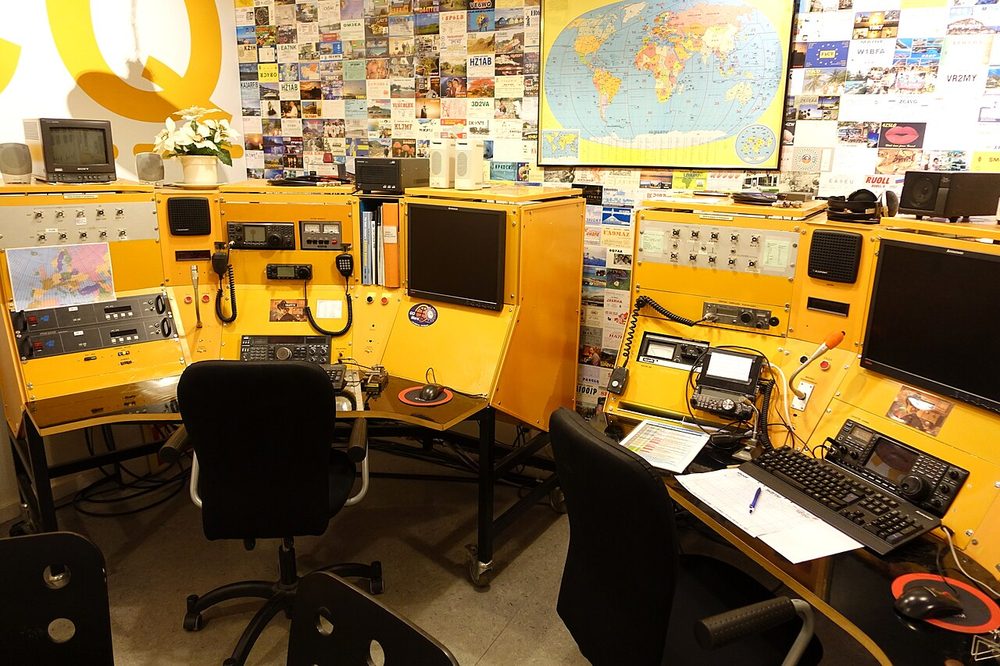
Details below were gathered from public club, ARRL, and repeater-database pages and last checked November 17, 2026. Meeting times and repeater settings change, so confirm with each group before you go or program a radio.
Do I need a license for mesh?
For ordinary Meshtastic and MeshCore use on 915 MHz radios in the US, no license is needed. Amateur (ham) radio is a separate service with its own license and rules, and it opens up voice, repeaters, HF, and emergency volunteer work. Operating as a ham on the same band carries extra rules, such as limits on encrypted messages, so read the FCC’s amateur rules or ask a local club before mixing the two. A Technician license is the usual starting point; see ARRL’s licensing guide.
Local clubs
Saint Paul Radio Club
The oldest amateur radio club in the Twin Cities, founded in 1931. General interest, educational and social. Newcomers and non-hams are welcome. The club lists license classes, license test sessions, and public-service event support among its activities.
- Meetings: first Friday of the month, September through May. 7:00 PM social, 7:30 PM meeting and program (a board meeting is open to visitors at 6:00 PM). Hybrid.
- Where: Albers Center Commons, Cretin-Derham Hall High School, 555 Hamline Ave. S., St. Paul
- Weekly nets (per the club’s newsletter): Wednesdays 7:30 PM on 28.310 MHz USB (HF) and 8:30 PM on 145.310 MHz FM (114.8 Hz tone)
Gopher Amateur Radio Club (University of Minnesota)
A technology-focused club that builds and runs wide-area repeater systems used across the Twin Cities. Its ARRL listing credits it with Minnesota’s first D-STAR and DMR systems, an APRS gateway, and a wide-area GMRS repeater in Falcon Heights. It sits at the edge of the ten-mile radius.
- Meetings: Saturdays at 2 PM, per its ARRL listing (confirm with the club first)
- Where: 106 Union Street SE, Minneapolis (East Bank campus, University of Minnesota)
- Systems (per the club): D-STAR on 443.425 MHz, DMR on 442.425 MHz, APRS on 144.390 MHz
Ramsey County Amateur Radio Association
Listed with ARRL as a public-service and emergency-focused club that runs repeaters. The listing says it meets the second Thursday of the month at 7:00 PM at 1425 Paul Kirkwold Drive, Arden Hills.
That listing has not been updated in years, so confirm the club is still active before you show up. The listing gives the call sign KB0UPW (also the trustee of the 146.925 Little Canada repeater below) and an old web address that no longer loads. We could not find a current website.
Repeaters in and near St. Paul
These are open, on-air repeaters in St. Paul and nearby Ramsey County suburbs, taken from RepeaterBook on November 17, 2026. The frequency shown is the repeater’s output, the one you listen to. Your radio transmits on a different frequency, set by the offset.
Analog FM voice
| Output (MHz) | Offset | Tone (PL) | Location | Trustee | Notes |
|---|---|---|---|---|---|
| 145.170 | −0.6 MHz | 100.0 | St. Paul | K0GOI | |
| 145.290 | −0.6 MHz | 114.8 | New Brighton | K0FCC | EchoLink |
| 145.310 | −0.6 MHz | 114.8 | St. Paul (U of St. Thomas) | K0AGF | Saint Paul Radio Club |
| 146.925 | −0.6 MHz | 107.2 | Little Canada | KB0UPW | |
| 147.120 | +0.6 MHz | none | Maplewood | W0MR | |
| 223.900 | −1.6 MHz | 100.0 | Falcon Heights (U of M) | KE0NA | 1.25 m band |
| 223.940 | −1.6 MHz | 100.0 | Arden Hills | KA0PQW | 1.25 m band |
| 223.980 | −1.6 MHz | 114.8 | Roseville | KF0ES | 1.25 m band |
| 442.450 | +5 MHz | 114.8 | Maplewood | K0AGF | Also Fusion |
| 442.600 | +5 MHz | 156.7 | Maplewood | AA0SA | |
| 443.350 | +5 MHz | 114.8 | St. Paul | W8WRR | Also D-STAR |
| 444.050 | +5 MHz | none | St. Paul | N0GOI | |
| 444.800 | +5 MHz | 114.8 | St. Paul | WD0HWT | |
| 444.950 | +5 MHz | 114.8 | Gem Lake | K0LAV |
Digital repeaters
These need a radio for that mode. An ordinary FM handheld cannot use them.
| Output (MHz) | Mode | Setting | Location |
|---|---|---|---|
| 442.025 (+5) | DMR | Color code 11 | St. Paul |
| 442.875 (+5) | DMR | Color code 11 | Little Canada |
| 443.150 (+5) | DMR | Color code 11 | White Bear Lake |
| 443.950 (+5) | DMR | Color code 1 | White Bear Lake (Benson Airport) |
| 442.075 (+5) | D-STAR | Arden Hills | |
| 444.000 (+5) | D-STAR | White Bear Lake | |
| 444.825 (+5) | Fusion / WIRES-X | Maplewood | |
| 444.075 (+5) | Fusion / WIRES-X | DCS D023 | Mounds View |
| 444.525 (+5) | Fusion / WIRES-X | DCS D025 | Mounds View |
| 442.500 (+5) | P25, AllStar, EchoLink | NAC 455 | St. Paul |
Repeater details change. Before programming a radio, check the current entry on RepeaterBook or with the Minnesota Repeater Council. We left off repeaters that RepeaterBook shows as off the air. The national 2-meter calling frequency, 146.520 MHz simplex, needs no repeater.
How to use a repeater
A repeater is a radio on a tall tower or building. It hears your weak signal on one frequency and rebroadcasts it, louder, on another. That lets two handhelds talk across town. You need at least a Technician license to transmit. Anyone can listen.
- Pick a repeater from the table that you can reach, then note its output frequency, offset, and tone.
- Program your radio. Set the receive frequency to the repeater’s output (for example 145.310). Set the offset direction and amount (−0.6 MHz on 2 meters, +5 MHz on 70 centimeters), so the radio transmits on the repeater’s input frequency. Set the tone (PL or CTCSS) to the listed value, for transmit only (often called “Tone” or “Encode”). Mode is FM. Free software such as CHIRP, or the RepeaterBook app, can load all this for you.
- Listen first. Monitor for a minute or two. If someone is talking, wait. Some times are reserved for nets, such as the Saint Paul Radio Club’s Wednesday evening net on 145.310.
- Press and hold the PTT button, count one second, then speak. That pause keeps the first words from being cut off. Release the button when you finish. You should hear the repeater’s short tone or a brief burst of noise.
- Say who you are. To make a general call, say “[your call sign], listening.” To reach someone, say their call sign, then “this is” and your call sign. Don’t say “CQ” on a repeater.
- Identify properly. The FCC requires you to give your call sign at least every 10 minutes during a conversation, and at the end of it.
- Keep it short and leave gaps. Many repeaters cut off a transmission after a few minutes. Pause between turns so others can break in, and stop at once if someone says “break” with emergency traffic.
If it doesn’t work: if you can hear the repeater but it doesn’t hear you, the usual causes are a wrong tone, the wrong offset direction, or too little power or height. Try again outdoors or higher up. If a repeater is listed as open, any licensed ham may use it. Closed repeaters, which require membership, are marked as such in RepeaterBook.
New to this? Many local clubs, including the Saint Paul Radio Club, are happy to help you program a first radio.
Ham radio apps
Useful on a phone whether you are studying for a license, programming a radio, or checking in to a net.
RepeaterBook
The most popular repeater directory. Search by location, see offsets and tones, and send the list to a radio. Some features need a paid RepeaterBook Plus plan.
HamStudy.org
Practice questions and flashcards for the Technician, General, and Extra exams.
EchoLink
Connects your phone to repeaters and other hams over the internet. A call sign must be verified before you can transmit.
aprs.fi
See APRS stations, weather stations, and tracked radios on a map.
APRSdroid
Android app that sends your position to the APRS network and shows nearby stations.
NOAA Weather Radio
Third-party app for hearing NOAA weather broadcasts on your phone. It is not an official National Weather Service app.
RepeaterBook and EchoLink are the two most useful for new hams. Store pages can change and some apps are updated or removed, so if a link fails, search the app name in your store.
Free and open-source ham radio apps
Most ham apps are not open source, and iOS has the fewest free options. These are the best-known open-source ones.
APRSdroid
Open-source (GPLv2) APRS app for Android. Send your position, see nearby stations and exchange messages through the internet, a TNC, or a radio audio cable. Android only.
Ham2K PoLo
A free portable logging app made for park, summit and field-day operating (POTA, SOTA). Its code is published on GitHub. Works on iPhone and Android.
Look4Sat
Open-source (GPL-3.0 or later) satellite tracker that predicts passes of amateur radio satellites. Android only.
CHIRP
Free, open-source software for programming many handheld and mobile radios from a computer. Not a phone app, but the standard tool for loading repeater lists. Works with ham and GMRS radios.
Organic Maps
Free, open-source offline maps built on OpenStreetMap, with no ads or tracking. Good for scouting a node site and for finding your way when the cell network is down.
There is no open-source APRS or satellite app for iPhone that we can recommend. iPhone users can use Ham2K PoLo, or the iOS apps listed above. Store pages can change and some apps are updated or removed, so if a link fails, search the app name in your store. F-Droid is a free app store for open-source Android apps. We are not affiliated with these projects.
Emergency communications: who to look for
Is there a local emergency ham frequency? We could not find a single published emergency frequency for St. Paul. Emergency ham communications here are organized by groups, and each group chooses its repeaters and frequencies and announces them to its members and in its own training nets. The one local group that publishes its net repeaters is Metro Skywarn (see below), which uses them during severe weather. The practical step is to join one of the groups below and learn their frequencies before you need them.
ARES (Amateur Radio Emergency Service)
Licensed volunteers who register their skills and equipment for emergencies and public-service events. Minnesota ARES has a Metro District covering the nine-county Twin Cities area, including Ramsey County. Members train and help staff events such as the Twin Cities Marathon. ARRL membership is not required.
Minnesota ARES Metro (sign-up and mailing list)
Statewide net list
RACES (Radio Amateur Civil Emergency Service)
A government-run emergency service. Hams register with their local emergency management agency and can be activated by it. We could not find a RACES page for Ramsey County (the county’s volunteer page does not list it), so ask Ramsey County Emergency Management or Minnesota ARES Metro how to take part.
Skywarn
Trained storm spotters who report severe weather to the National Weather Service. It is a common first volunteer role, and it needs training rather than a long commitment. Metro Skywarn is a volunteer nonprofit that trains spotters and runs an amateur radio net when severe weather threatens. Its 2026 classes ran March through June and are finished, so watch its site for the next schedule.
Net repeaters (from Metro Skywarn’s site):
- Primary: 146.700 MHz (−), PL 127.3, downtown Minneapolis
- Primary: 147.210 MHz (+), PL 100.0, Burnsville
- Back-up: 145.170 MHz (−), PL 100.0, St. Paul (also in the table above)
- Back-up: 147.120 MHz (+), no tone, Maplewood (also in the table above)
- More back-ups: 146.670 MHz (−) PL 114.8 Fridley/Blaine; 146.760 MHz (−) St. Paul receive site, PL 100.0
Net control announces moves to back-up repeaters. Sign up for its alert list to learn when a net is active.
Other groups to know
Volunteer groups such as the Red Cross, the Salvation Army’s SATERN network, and Minnesota Voluntary Organizations Active in Disaster (MNVOAD) also work with ham operators. The City of Saint Paul lists disaster volunteer organizations too.
Also worth programming into a radio: NOAA Weather Radio for St. Paul is 162.550 MHz (receive only). The national 2-meter calling frequency is 146.520 MHz simplex. Neither is a substitute for a local net.
In a real emergency, call 911. Ham radio and mesh networks are backups for when normal communication fails, not replacements for emergency services.
Mesh complements these groups. A MeshCore or Meshtastic node can carry short text messages when cell service fails, and ARES members can use it for training and backup. If you join a group, ask how they feel about mesh.
Looking for a radio? See our recommended ham radio gear. The buttons on that page are Amazon affiliate links. As an Amazon Associate I earn from qualifying purchases, at no extra cost to you, and the commissions go toward putting more radios in the community’s hands. Receipts available on request. Disclosure.