GMRS: licensing, repeaters, and emergencies
Please read the FCC rules. GMRS is licensed and regulated by the FCC. Know what is allowed before you transmit: FCC rules for GMRS (Part 95).
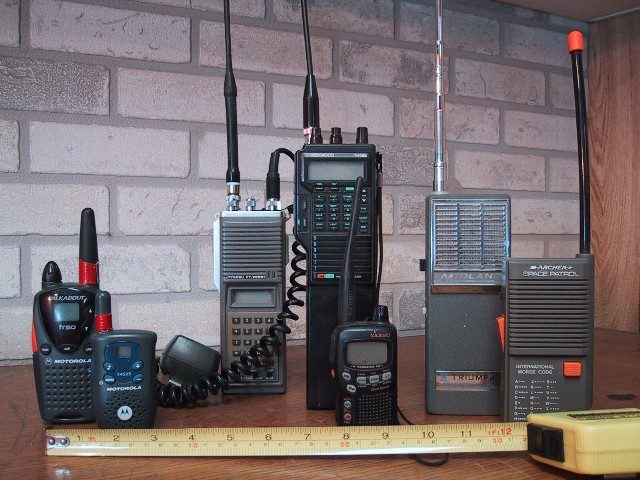
GMRS (General Mobile Radio Service) is a licensed UHF voice service around 462 and 467 MHz. It is a good fit for families and groups who want voice radio with more range than a toy walkie-talkie, and it complements text-based mesh. Details were gathered from public FCC-related guides, RepeaterBook, and local pages, and last checked November 17, 2026. Rules and fees can change, so confirm anything important on the FCC’s GMRS page.
Licensing
What you need
- An FCC license. It costs $35 and lasts 10 years. Older pages that quote $70 are out of date.
- No exam. You apply and pay online.
- A GMRS-certified radio. Only radios the FCC has certified for GMRS may be used.
Who is covered
One license covers the licensee and their immediate family. Under FCC rule 95.1705 that means the licensee’s spouse, children, grandchildren, stepchildren, parents, grandparents, stepparents, brothers, sisters, aunts, uncles, nieces, nephews, and in-laws. Friends, coworkers and other non-relatives are not covered and need their own license. To get a new license you must be at least 18, and licenses go to individuals, not businesses.
GMRS vs. FRS vs. ham
FRS radios are license-free but limited to low power. They share channels 1–22 with GMRS. GMRS allows more power, repeaters, and detachable antennas. Ham radio is a separate service with its own exam; a ham license does not cover GMRS, and a GMRS license does not cover ham bands.
How to apply
- Get a free FCC Registration Number (FRN) by registering in the FCC’s CORES system. If you already have an FCC username, use it.
- Log in to the FCC’s Universal Licensing System (ULS) and apply for a new license under radio service code ZA (Form 605).
- Pay the $35 fee online.
- When the FCC grants it, you get a call sign, usually within a few days. It begins with W, for example
WXXX123.
Family members use your call sign. They don’t need their own. Start at the FCC’s GMRS page, and ignore third-party sites that charge extra to “help” you apply. The fee goes only to the FCC.
Local GMRS groups
The local scene
We could not find an active GMRS club with its own website within ten miles of St. Paul. Local GMRS activity runs mostly through individual repeater owners, and many local users are also hams. A good place to find people is the myGMRS.com repeater directory and forums, and the GMRS section of RepeaterBook.
Nearby and related
The Gopher Amateur Radio Club (U of M) says in its ARRL listing that it runs a wide-area GMRS repeater in Falcon Heights on 462.650 MHz. We couldn’t confirm that one in RepeaterBook, which lists a different Falcon Heights repeater (462.600, in the table below), so ask the club. See the ham section.
West Hennepin Radio runs a membership-based GMRS repeater group on the west side of the metro, outside our ten-mile radius.
GMRS repeaters near St. Paul
These are the GMRS repeaters near St. Paul that RepeaterBook lists as open and on the air. The frequency shown is the repeater’s output, the one you listen to. GMRS repeaters always transmit 5 MHz higher than they receive, so your radio transmits on the frequency 5 MHz above the output.
| Output (MHz) | Your transmit (MHz) | Channel | Tone (PL) | Location | Notes |
|---|---|---|---|---|---|
| 462.600 | 467.600 | 17R | 141.3 | Falcon Heights | Open Repeater Initiative; travel tone |
| 462.575 | 467.575 | 16R | 114.8 | Woodbury | Edge of our radius |
“Open” means the owner lists it as open to licensed GMRS users, but repeaters are privately owned, and some local ones are closed and need the owner’s permission. The Open Repeater Initiative (ORI) marks repeaters whose owners have agreed to open use. Settings come from RepeaterBook and can be out of date, so check the listing and the owner before relying on one. Other repeaters appear in the directory too, including some farther south in Dakota County.
How to use a GMRS repeater
A repeater is a radio at a high spot that hears your signal and rebroadcasts it, so handhelds can reach across town. On GMRS, repeaters use channels 15R–22R, with outputs from 462.550 to 462.725 MHz.
- Check your radio. It must be FCC-certified for GMRS and repeater-capable. Many cheap blister-pack radios and all FRS-only radios cannot transmit on repeater input frequencies, so check the box or manual for “repeater” or “duplex.”
- Pick a repeater from the table or from RepeaterBook. If it isn’t listed as open, ask the owner for permission first.
- Program it. Receive on the repeater’s output (for example 462.600). Transmit on the output plus 5 MHz (467.600). Many radios already have a repeater channel (such as 17R) that sets this automatically. Then set the tone (PL or CTCSS) to the listed value for transmit. Mode is narrowband FM.
- Listen first. Wait for any conversation to end before you transmit.
- Press and hold the PTT button, count one second, then speak. Release when you finish.
- Identify with your FCC call sign when you finish talking and at least every 15 minutes during a long conversation. To start a call, say something like “[your call sign], monitoring.” Your family says your call sign, too.
- Keep it short and leave gaps so others can join, and stop at once if someone has an emergency.
Talking without a repeater (simplex): on channels 1–22 you can talk directly radio to radio. Set both radios to the same channel and tone. Tones such as “privacy codes” only filter what you hear. They do not make a conversation private.
If it doesn’t work: if you hear the repeater but it doesn’t hear you, check the transmit frequency (output plus 5 MHz), the tone, and your power and height. Try again outdoors or higher up.
GMRS apps
GMRS has fewer apps than ham radio, but these help you find repeaters and program radios.
myGMRS
The main GMRS repeater directory and community, with a repeater map and forums.
RepeaterBook (GMRS section)
RepeaterBook also lists GMRS repeaters, including Minnesota, on its website.
BTECH GMRS Programmer
For programming compatible BTECH GMRS radios from a phone. Check that your exact radio is supported first.
NOAA Weather Radio
Third-party app for hearing NOAA weather broadcasts. Useful in storms when you lose power.
Check which apps work with your radio before buying one. Store pages can change and some apps are updated or removed, so if a link fails, search the app name in your store.
Free and open-source tools for GMRS
Almost every GMRS app is closed source. These free open-source tools are the useful exceptions.
CHIRP
Free, open-source software for programming many GMRS handhelds and mobiles from a computer, including repeater channels with tones. Check that your radio model is on its supported list first. Not a phone app.
Organic Maps
Free, open-source offline maps built on OpenStreetMap, with no ads or tracking. Good for scouting a node site and for finding your way when the cell network is down.
OsmAnd
Open-source offline maps with contour lines and terrain detail, which helps when judging line of sight. The free store versions limit some features; the F-Droid build is fully free.
There is no well-known open-source GMRS repeater directory app, so use myGMRS or RepeaterBook above for repeater lists. Store pages can change and some apps are updated or removed, so if a link fails, search the app name in your store. F-Droid is a free app store for open-source Android apps. We are not affiliated with these projects.
Emergency use: what to know
Is there a GMRS emergency channel? Not an official one. The FCC once reserved 462.675 MHz for emergencies and traveler assistance, but dropped that rule around 1999. By convention, many GMRS users and volunteer teams still treat channel 20 (462.675 MHz) with a 141.3 Hz tone as an informal travel and emergency channel. Some groups also suggest FRS channel 1 (462.5625 MHz) with no tone as an emergency calling channel, which the FCC has not made official. Neither is guaranteed to be monitored.
Ramsey County CERT
Community Emergency Response Teams train residents in disaster preparedness and basic response. The program is run through the Ramsey County Sheriff’s Office. The 2026 academy was four Tuesday evenings (6–9 PM) in April, is free, and is open to Minnesota residents 18 and older who pass a background check. Questions: 651-266-7332.
County emergency response
Ramsey County lists the volunteer organizations that work with it during disasters (CERT, Medical Reserve Corps, Neighborhood Watch, Volunteers in Police Service, and Voluntary Organizations Active in Disaster). It recommends affiliating with one before an emergency, not during one.
REACT
REACT teams are volunteer groups that monitor emergency channels, including GMRS channel 20, in many parts of the country. We couldn’t find an active REACT team in St. Paul. If you know of one, let us know.
Make a plan before you need one. Agree on a channel and tone with your family or neighbors, test it, and keep radios charged. Mesh text messages can back up GMRS voice when you are out of range.
In a real emergency, call 911. GMRS and mesh are backups for when normal communication fails.
Looking for a radio? See our recommended GMRS gear. The buttons on that page are Amazon affiliate links. As an Amazon Associate I earn from qualifying purchases, at no extra cost to you, and the commissions go toward putting more radios in the community’s hands. Receipts available on request. Disclosure.